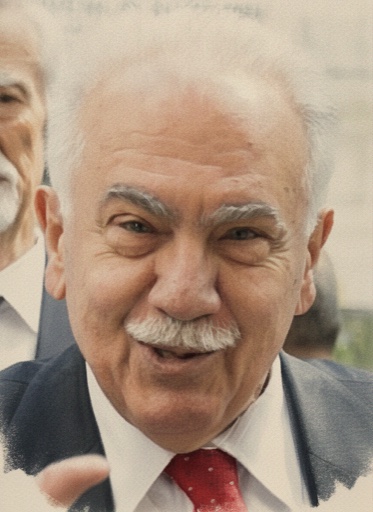
Doğu Perinçek
@Dogu_Perincek · Lebanon, Syria, Turkey, Iraq, Yemen
Doğu Perinçek is a Turkish author, PhD at public law, and politician.
At the breakfast event organized by our Vatan Party İzmir Provincial Presidency, we met with the İzmir press and İzmir residents.
Translated from TurkishAt the breakfast event organized by the Izmir Provincial Presidency of the Homeland Party, we assessed the historic significance for Turkey of prosecuting the leaders of the FETÖ, Süleymancılar, Adnan Oktar, and Kuytul organizations. A repeat of the event is on Ulusal Kanal.
Translated from Turkish (Türkiye)At the breakfast event organized by our İzmir Provincial Directorate of the Vatan Party, we assessed the historical significance for Turkey of prosecuting the leaders of FETÖ, the Süleymancılar, Adnan Oktar, and the Kuytul organization.
Translated from TurkishAt the press conference we will hold in Izmir, we will assess the historical significance for Turkey of prosecuting the leaders of the FETÖ, Süleymancılar, Adnan Oktar, and Kuytul organizations. September 1, 2026, Tuesday, 13:30, Kordon Hotel Çankaya
Translated from TurkishWe ask Allah to have mercy on our citizens who lost their lives in the passenger ship disaster that occurred off Girne, and offer our condolences to their families and the Turkish Cypriot people. We hope that our missing compatriots are found safe and sound as soon as possible, and wish our injured a speedy recovery.
Translated from TurkishWe wholeheartedly celebrate Victory Day of the Turkish Nation and the Turkish Armed Forces together with Mr. Ethem Sancak and our Deputy Chairman. The agenda is again the Mediterranean agenda, that is, the agenda of 1922; today, in 2026, 104 years later, it is the same Mediterranean agenda. At that time, our commander and Mustafa Kemal Pasha, who stood at the head of the revolutionary government, had given this order: on September 1, 1922, “Armies of the Grand National Assembly, your first objective is the Mediterranean, forward!” Why did I feel the need to repeat this order? Because at that time the armies were not under the command of the Istanbul government, the sultan’s government; they were not the sultan’s army. They were the army of the revolution, the army of the revolutionary Republic established in Ankara. Atatürk pointed to this when he gave the order: armies of the Turkish Grand National Assembly, your first objective is the Mediterranean, forward. Therefore, behind and at the head of the August 30 victory stood a revolutionary government. There was the revolutionary government established in Ankara on April 23, 1920. Thus, because we made a revolution, we were able to drive the enemy into the sea. If the Istanbul government had continued to remain at our head, our War of Independence would have become very difficult under the rule of the Istanbul government. That is why Atatürk and his comrades went to Anatolia. With the Erzurum Congress, the Sivas Congress, and the opening of the Grand National Assembly in Ankara, a new revolutionary assembly and revolutionary government were established, and that revolutionary government and assembly reorganized the Turkish Armed Forces. The Turkish Armed Forces organized by that revolutionary assembly and revolutionary government mobilized the people of Turkey and, with the Turkish army, drove the enemy into the Mediterranean. This is a very, very important lesson. In other words, we were saved through revolution. Otherwise, under a sultan’s government and within the status quo, there was no liberation for us. Now let us come to today. Today, 104 years later, the agenda is again the Eastern Mediterranean agenda. The United States of America has replaced the England of that time. The United States, today’s patron of imperialism, has taken Israel and Greece alongside it and formed an alliance in the Eastern Mediterranean. An alliance, that is, an armed alliance targeting Turkey. We see that this alliance is conducting the Noble Nida and Nemesis exercises in the Eastern Mediterranean, building shelters in Southern Cyprus and on the Aegean islands. Greece has practically fallen under American occupation. As our President Mr. Tayyip Erdoğan also stated, America has established bases at nine locations along the Greek coast, and on the opposite side of the Meriç River, as you may remember, one year ago in May 2025 it held exercises with tanks and artillery to cross the Meriç River targeting Turkey. We also have a northern front. This is a continuation of the Mediterranean front. Ukraine, again under the direction of the United States, is threatening Turkey from the north and openly carrying out attacks on our ships with UAVs and UCAVs. Therefore, the agenda is again the agenda of 1922. This agenda is consequently an agenda of heroism and sacrifice. There are threats before us that we can confront through the sacrifice of the Turkish nation, through the heroism of the Turkish Armed Forces and the staff work of 1922. What was that staff work at the time? Against the threat from Europe and America, Britain and France stood before us; they sent Greece against us, and in the east they sent the Armenians against us. So what did the newly established government in Ankara do? It brought Soviet Russia to its side. The tsarist system had been overthrown by Lenin and a Soviet Russia, a revolutionary Russia, was established in its place. Thus the two revolutionary governments and states of Asia, Soviet Russia and Turkey, joined hands and stood shoulder to shoulder. We see this in the famous photographs of August 26 as well. There are famous photographs from August 26. Mustafa Kemal Pasha is watching the enemy forces through binoculars. But behind him, lying side by side, are Russian commanders wearing the coat and headgear of the Russian Bolshevik revolution, not the Turkish overcoat and kalpak worn by our commanders. It is a very valuable and important photograph. As that photograph also shows, Soviet commanders were beside us at our Kocatepe, the headquarters of a matter of life and death. They were sharing our fate. Had we been defeated, they too would have been martyred alongside Mustafa Kemal Pasha. That is staff work. On that day, Turkey’s War of Independence against Anglo-French imperialism could succeed by taking the Soviet revolution alongside it. That is the staff work Mustafa Kemal Pasha’s revolutionary government put into practice. So what is the legacy of August 30 left to us today? First, the sacrifice of the Turkish nation. That sacrifice began with the Italo-Turkish War in 1912 and the Balkan Wars. Think of it: a country that had been at war for ten, twelve, twenty-two years. There were almost no men left in the villages. Those who remained were disabled: no leg, no arm; and then only women remained. Women harvested the grain and baked the bread. There had been a huge loss of population. The Turkish nation lost 1.5 million people in the First World War. The August 30 victory and the Turkish Armed Forces were won through great sacrifice. The Turkish Armed Forces are now a new revolutionary army, no longer the sultan’s army. In fact, this revolutionary army had begun to be built in the Balkan Wars before the First World War. Talat Pasha and Enver Pasha modernized and rejuvenated our army before the First World War. It was a revolution, the revolution of 1908. There too, a revolutionary government was raising Turkey to its feet. Thus there is an army and a Turkish Armed Forces tradition of staff work coming from those years: an army made younger, dynamic, revolutionary; and, thirdly, a heritage of staff work. That is, the accumulated experience reached during those long years of war by the Turkish revolutionaries. Let us begin with the Young Ottomans: Namık Kemal and Mithat Pasha; then Talat Pasha and Enver Pasha; and after them Mustafa Kemal Pasha. Mustafa Kemal Pasha was a revolutionary in the generation of Talat Pasha and Enver Pasha, and in the third generation after them he was a revolutionary as its leader. This is also a legacy of staff work arising from such a great accumulation. Today, in the face of the threats directed at us from the Eastern Mediterranean, these three great legacies give us great strength on our shoulders: the Turkish nation’s legacy of sacrifice, the Turkish Armed Forces’ legacy of heroism, and the legacy of staff work continued today by the Homeland Party. We are again carrying out staff work today. What is it? America is before us, Israel is before us, Greece is before us; Ukraine is in the north, and Europe, France and the others are with them. There is a threat before us with nuclear weapons and navies. Yes, we have heroism, sacrifice and staff work, but we must also mass a deterrent weight in the Eastern Mediterranean. What is that weight? Russia is already at war with NATO. Iran has just defeated America. China is far away, waiting alert and making preparations against American hostility. Then our accumulated staff work is objectively ready in the historical picture before us. What is it? An alliance of Turkey, Russia, Iran and China. So today’s staff work, like the staff work of 1922, means taking Asia alongside us and entering a historical process in which we face the declining, decaying, sinking American imperialism and the Zionism of Israel coming from the West, with Western Europe also aligned with them while itself inclined to change sides at any moment. The Turkish nation is the owner of the legacy of sacrifice, our heroic army continues the legacy of heroism, and the Homeland Party, as the holder of the Turkish revolution’s legacy of staff work, stands at the threshold of the great victories ahead of us, all together. We offer our respects.
Translated from TurkishWe are wholeheartedly celebrating the Victory Day of the Turkish Armed Forces and the Turkish nation, together with our esteemed deputy chairman Ethem Sancak. The agenda is once again the Mediterranean agenda, that is, the agenda of 1922; today too, in 2026, 104 years later, it is the same agenda, the Mediterranean agenda. At that time our commander Mustafa Kemal Pasha, who stood at the head of the revolutionary government, gave this order: on September 1, 1922, “Armies of the Grand National Assembly, your first target is the Mediterranean, forward!” Why did I feel the need to repeat this order? Because at that time the armies were not under the command of the Istanbul government, the sultan’s government; they were not the sultan’s army. They were the army of the Revolution, the army of the revolutionary Republic established in Ankara. Atatürk was pointing to this when he gave the order: Armies of the Grand Turkish National Assembly, your first target is the Mediterranean, forward. Therefore, behind the August 30 Victory, and at its head, there was a revolutionary government. There was a newly established revolutionary government founded in Ankara on April 23, 1920. Therefore, we were able to drive the enemy into the sea because we made a revolution. If the Istanbul government had continued to remain at our head, our War of Independence would have become very difficult under the sultanate of the Istanbul government. That is why Atatürk and his comrades went to Anatolia. With the Erzurum Congress, the Sivas Congress, and the opening of the Grand National Assembly in Ankara, a new revolutionary assembly and revolutionary government were established, and that revolutionary government and revolutionary assembly reorganized the Turkish Armed Forces. The Turkish Armed Forces organized by that revolutionary assembly and revolutionary government mobilized the Turkish people and, with the Turkish army, drove the enemy into the Mediterranean. This is a very, very important lesson. In other words, we were saved through revolution. Otherwise, there was no salvation for us within the status quo under the sultan’s government. Now let us come to the present. Today too, 104 years later, the agenda is again the agenda of the Eastern Mediterranean. The United States replaced England of that time. The United States, the patron of imperialism today, took Israel and Greece alongside it and formed an alliance in the Eastern Mediterranean. That is, it formed an armed alliance targeting Turkey. We see that this alliance is conducting “pulse-dynamism” exercises in the Eastern Mediterranean, building shelters in Southern Cyprus, and building shelters on the Aegean islands. Greece has almost fallen under American occupation. As our President, Mr. Tayyip Erdoğan, also pointed out, America established bases at nine locations along the Greek coastline, and, as you will remember, a year ago, in May 2025, it conducted exercises on the opposite side of the Meriç River to cross with tanks and artillery, targeting Turkey. We also have a northern front. This is a continuation of the Mediterranean front. Ukraine is threatening Turkey from the north, again under the direction of the United States, and is openly carrying out attacks on our ships with UAVs and armed drones. Therefore, the agenda is again the agenda of 1922. It is an agenda of heroism and sacrifice. There are threats before us that we can confront only through the sacrifice of the Turkish nation, with the heroism of the Turkish Armed Forces and the strategic planning of 1922. What was that strategic planning at the time? England and France stood against us in the face of the European and American threat; they drove Greece against us, and in the east they drove the Armenians against us. What did the newly established government in Ankara do in response? It took Soviet Russia alongside it. Lenin and his comrades had overthrown the tsarist regime, and in its place a Soviet Russia, a revolutionary Russia, was established. Thus the two revolutionary governments and states of Asia, Soviet Russia and the newly established Turkey, joined arms and stood shoulder to shoulder. We see this in the photographs of August 26 as well. There are famous photographs of August 26. Mustafa Kemal Pasha is watching the enemy forces through binoculars. But in the background, Russian commanders are lying there in the clothing of the Russian Bolshevik Revolution, with its coat and headgear, not in the Turkish greatcoat and kalpak worn by our commanders. It is a very valuable and important photograph. As we see in that photograph, Soviet commanders were beside us at our Kocatepe, the headquarters of a matter of life and death. They were sharing our fate. If we had been defeated, they too would have been martyred together with Mustafa Kemal Pasha. This is strategic planning. On that day, Turkey’s War of Independence against British-French imperialism could succeed by taking the Soviet revolution alongside it. That is the strategic planning that Mustafa Kemal Pasha’s revolutionary government put into practice. So what is the legacy of August 30 left to us today? First, the sacrifice of the Turkish nation. That sacrifice began around 1912, with the Tripolitanian War and the Balkan Wars. Think of this sacrifice: a country that had been fighting for 12, 22, or 10 years. There were almost no men left in the villages. Those who remained were disabled: no leg, no arm, and then only women remained. The women were cutting the grain. There had been a huge loss of population. The Turkish nation lost 1.5 million people in the First World War. The August 30 victory and the Turkish Armed Forces were won through great sacrifice, and the Turkish Armed Forces became a new revolutionary army. It was no longer the sultan’s army. In fact, this revolutionary army had begun to be built before the First World War, during the Balkan Wars. Talat Pasha and Enver Pasha rejuvenated our army before the First World War. It was a revolution, the revolution of 1908. There too, a revolutionary government was raising Turkey to its feet. Therefore, our third legacy is an army of strategic experience: the accumulation of the Turkish Armed Forces that came from those stages, a young, dynamic revolutionary army. And thirdly, the accumulation of strategic experience. That is, the legacy reached by those Turkish revolutionaries during the long years of war, beginning with the Young Ottomans: Namık Kemal, Mithat Pashas, then Talat Pashas and Enver Pashas, followed by Mustafa Kemal Pashas. Mustafa Kemal Pasha was a revolutionary in the generation of Talat Pasha and Enver Pasha, and then he was a revolutionary as the leader of the third generation that followed him. This too is a great legacy of strategic experience arising from that accumulation. Today, in the face of the threats directed at us from the Eastern Mediterranean, these three great legacies give us great strength on our shoulders: the legacy of the Turkish nation’s sacrifice, the legacy of the Turkish Armed Forces’ heroism, and the legacy of strategic planning that the Homeland Party continues today. We are also practicing strategic planning today. What is it? America, Israel, and Greece stand before us; Ukraine is in the north; Europe, France, and so on are with them; and there is a threat from powers possessing nuclear weapons and navies. Yes, we have heroism, sacrifice, and strategic experience, but we must also mass a deterrent weight against that threat in the Eastern Mediterranean. What is that weight? Russia is already at war with NATO. Iran has just defeated America. China is far away, waiting alert and making preparations against America’s hostility. Therefore, our strategic experience is objectively ready in this historical picture right now. What is it? An alliance of Turkey, Russia, Iran, and China. Thus, today’s strategic planning, like the strategic planning of 1922, is to bring Asia to our side and, together with Asia, enter a historical process in which we face the collapsing, decaying, sinking American imperialism and the Israeli Zionism coming from the West, as well as Western Europe, which is united with them but is inclined to change sides at any moment. Today the Turkish nation is the owner of the legacy of sacrifice, our heroic army continues the legacy of heroism, and the Homeland Party, as the holder of the strategic legacy of the Turkish Revolution, stands today together with all of us on the threshold of the great victories ahead. We offer our respects to our valued viewers. Doğu Perinçek, Chairman of the Homeland Party.
Translated from Turkish (Türkiye)