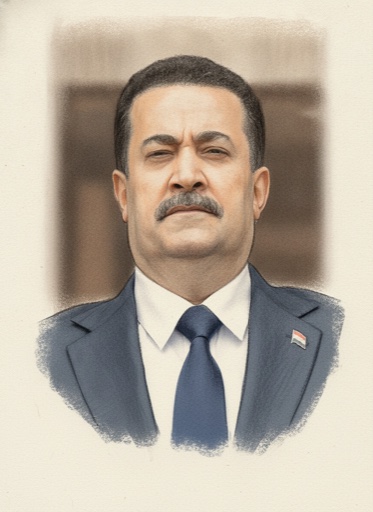
Muhammad Shia' al-Sudani
@mohamedshia · Lebanon, Syria, Turkey, Iraq, Yemen
Muhammad Shia' al-Sudani is a former prime minister of Iraq.
In the name of Allah, the Most Gracious, the Most Merciful {Every soul shall taste death} Allah the Most High and Great has spoken the truth. We extend our condolences to the president of the Kurdistan Democratic Party, Mr. Masoud Barzani, on the death of the eldest brother in his family, Mr. Abdul Wahid Barzani, may Allah forgive him. We ask Allah, the Most High, the Almighty, to envelop him in His vast mercy, grant him a place in His spacious gardens of Paradise, and inspire his family and loved ones with patience and solace.
Translated from Arabic"We have adopted the principle of balance in our foreign policy, kept away from a policy of axes, and opened up to everyone based on shared interests and mutual respect." From this standpoint, in our article published on the website of the Iraqi Group for Foreign Affairs, titled: «Productive Diplomacy: Iraq When It Leverages Its Strategic Position», we discussed our vision of how to employ foreign policy as an effective tool to strengthen Iraq's economic interests, support development paths, and consolidate its regional and international standing.
Translated from ArabicWe condemn in the strongest terms the criminal attack that targeted security personnel while they were carrying out their duty in the Al-Dora area, resulting in the martyrdom of a number of members of the security services and injuring others. It is a rejected and condemned act, and an assault on the state's prestige and the rule of law. Targeting security personnel as they perform their duty to protect citizens requires a clear and decisive stance from everyone, and weapons must not be allowed to become a means of imposing one's will or threatening the security of citizens and state institutions. We have always affirmed that enforcing the law on everyone, without exception, is the foundation of security and stability, and that a strong state cannot be built without it. As we renew our full support for our security forces in carrying out their duties, we call on the competent authorities to take the necessary legal measures, uncover the circumstances of the incident, hold those involved accountable, and prevent the recurrence of such acts that threaten the security of society and the state's prestige. Mercy and divine favor for our martyrs, patience and solace for their families and relatives, and a speedy recovery for the wounded and injured.
Translated from ArabicAs the date for the end of the international coalition mission in Iraq on September 30, 2026 approaches, in accordance with the understandings and agreements completed during the period when we assumed responsibility for the government, Iraq stands before an important national obligation that requires the highest degree of wisdom and responsibility. Ending the coalition mission was a step on the path to restoring Iraq's full sovereignty over its land and skies and strengthening the independence of its national decision. This responsibility can only be completed by establishing a basic principle: that weapons and the decision to use them must be exclusively in the hands of the state and its constitutional institutions. Restricting weapons to the hands of the state is not a project to exclude anyone, and it should not be an entry point to confrontation or conflict. Rather, it is a national obligation to build a strong state capable of protecting all its people, safeguarding their security and rights, and preventing Iraq from being used as an arena for the conflicts of others. At the same time, addressing this sensitive issue requires a broad and rational national dialogue in which all political and social forces participate, far from the language of threats, accusations of treason, escalation, and heated speeches and statements that Iraq's enemies exploit. Great issues are not addressed through the logic of victory by force, but through wisdom and understanding and by putting the national interest first. We must remember that the most dangerous thing Iraq may face is not disagreement among its people, but the transformation of that disagreement into strife or internal fighting. Therefore, preserving unity and civil peace is a responsibility borne by everyone, especially the forces that possess political and social influence. Iraqis, including those who still retain weapons, have paid a heavy price to restore security and stability, and it is unacceptable to allow any dispute or regional circumstance to return us to the cycle of internal conflict. Iraq is capable of moving into a new phase: a fully sovereign state, independent in its decisions, possessing strong security and military institutions, while maintaining balanced relations with its Arab, regional, and international surroundings. Only in this way can we deny the opportunity to everyone who wants to drag Iraq into strife or turn its land into an arena for conflict, and protect our country's future through the hands of its people and a united national will.
Translated from Arabic